

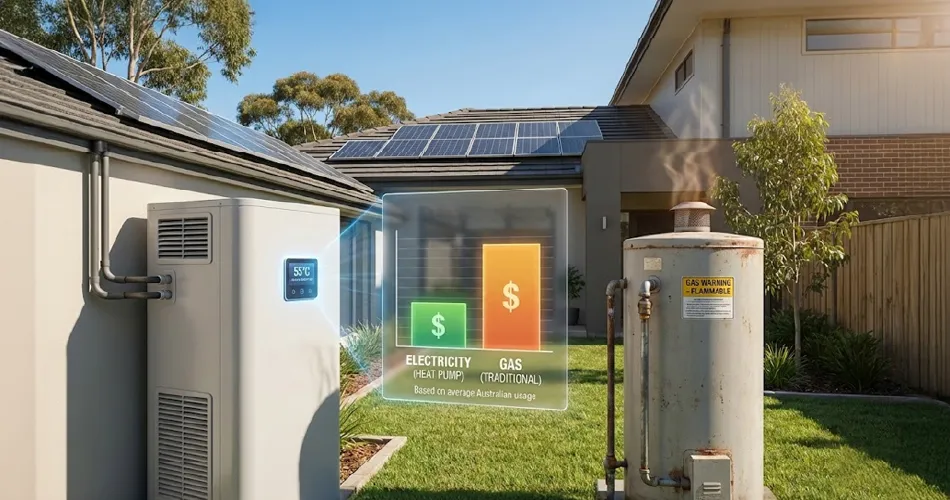
Energy costs across Australia continue to rise, and hot water remains one of the biggest contributors to household power bills. As gas prices increase and electrification accelerates, more homeowners are seriously comparing heat pump vs gas hot water to work out what actually costs less to run over time.
For years, gas was considered the cheaper option. That assumption no longer holds true for most households. Today, the decision comes down to running costs, efficiency, solar compatibility, and how long you plan to stay in the property.
This article breaks down heat pump hot water vs gas in real Australian conditions. We look beyond upfront price tags and focus on long-term running costs, including the impact of solar power and Australia’s climate.
Who This Guide is for?
- Households currently on gas assessing whether to replace their gas water heater with heat pump technology
- Families using or planning rooftop solar and wanting hot water systems that align with daytime energy generation
- People who are uncertain whether heat pump hot water systems are appropriate for the size of their household, climate, or pattern of use.
- People weighting efficiency, emissions, and future energy costs rather than focusing only on upfront price
- Anyone looking to read a pragmatic, non-sales comparison of heat pump hot water vs gas under real Australian conditions
How Heat Pump and Gas Hot Water Systems Work
A heat pump system works very differently from traditional water heaters. Instead of generating heat directly, an air source heat pump extracts warmth from the surrounding air and uses it to heat water stored in a tank. This process uses electricity but delivers three to four units of heat for every unit of power consumed.
Gas hot water systems operate by burning natural gas. Storage systems heat and store water continuously, while instantaneous systems heat water on demand. Both rely on a constant gas supply and are far less efficient in energy terms.
The efficiency gap is the core reason the heat pump vs gas hot water comparison has shifted in favour of heat pumps. Gas systems convert fuel to heat at around 80–90 percent efficiency. Heat pumps routinely exceed 300 percent efficiency.
Running Cost Comparison for Australian Homes
To compare electric heat pump and gas hot water, assume a typical 3 to 4 person Australian household using 180–220 litres of hot water per day.
Scenario 1: No Solar Installed
Without solar, a modern heat pump hot water system generally has lower running costs than gas when used under comparable household conditions.
Under the same conditions, gas hot water systems typically have higher ongoing running costs due to fuel pricing and fixed supply charges.
Scenario 2: With Rooftop Solar
When paired with solar, heat pump hot water systems can be scheduled to run during peak generation hours. This reduces grid electricity use dramatically.
In homes with rooftop solar, heat pump hot water systems can operate with minimal reliance on grid electricity.
Scenario 3: Off-Peak or Time-of-Use Tariffs
Heat pumps work exceptionally well with off-peak or controlled load tariffs. Gas pricing does not offer the same flexibility and remains exposed to ongoing price volatility.
Clear takeaway: in most real-world scenarios, heat pumps are cheaper to run than gas, especially once solar is introduced.
Is Heat Pump Hot Water Cheaper Than Gas in Australia?
Yes. For most Australian households, heat pump vs gas hot water is no longer a close contest.
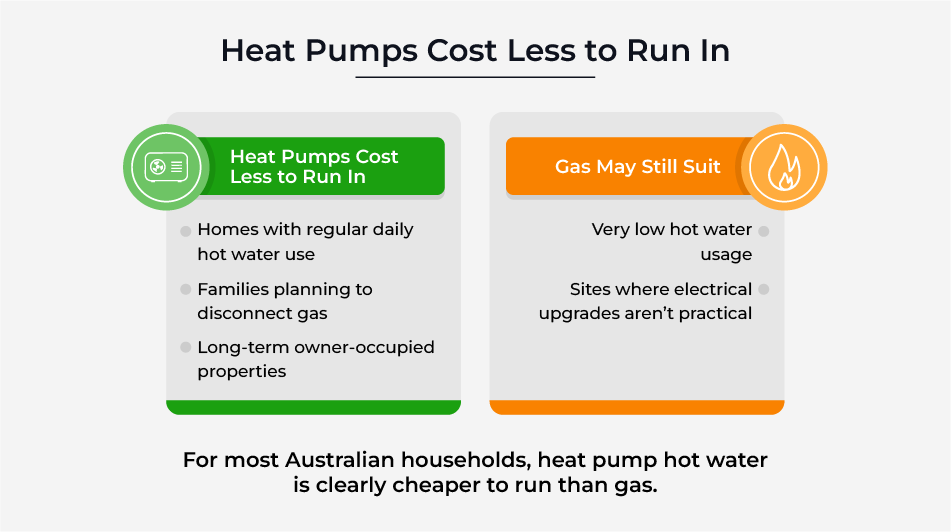
Heat pumps are cheaper to run in:
- Homes with rooftop solar
- Families with consistent daily hot water use
- Properties planning to disconnect gas entirely
- Long-term owner-occupied homes
Gas can still compete in limited situations, such as properties with extremely low hot water usage or where electricity supply upgrades are not feasible. However, these cases are becoming less common as grid infrastructure improves.
For the majority of homes, heat pump hot water vs gas clearly favours heat pump systems on running cost alone.
Is a Heat Pump Better Than Gas for Australian Homes?
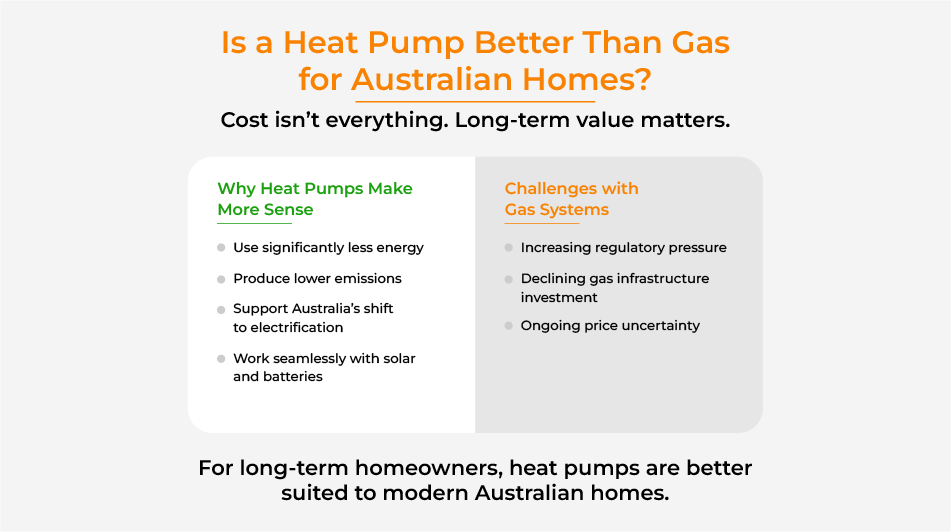
Cost is only part of the equation. When comparing heat pump and gas hot water, broader factors matter.
Heat pumps:
- Use significantly less energy
- Produce lower emissions
- Align with Australia’s move toward electrification
- Integrate seamlessly with solar and batteries
Gas systems face increasing regulatory pressure, declining infrastructure investment, and ongoing price uncertainty. For families planning to stay in their home long term, hot water heat pumps offer better future-proofing and lower exposure to fuel price shocks.
From an ownership perspective, heat pumps are simply better suited to modern Australian homes.
Replacing a Gas Water Heater with a Heat Pump
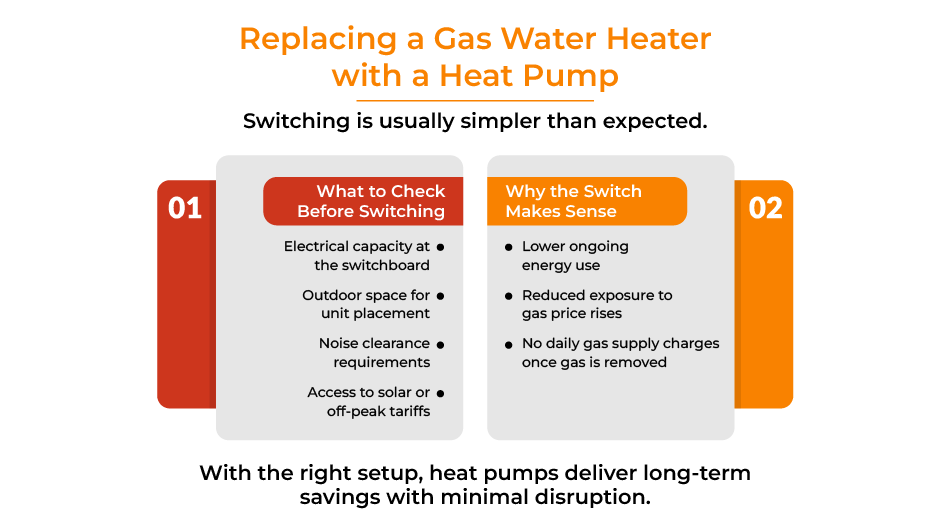
Many homeowners worry that switching is complicated. In reality, most properties can replace gas water heater with heat pump systems without major disruption.
Before switching, check:
- Electrical capacity at the switchboard
- Outdoor space for unit placement
- Noise clearance requirements
- Access to solar or off-peak tariffs
When installed correctly, heat pump systems often recover their upfront cost over time through reduced energy use, particularly in solar-equipped homes. Once, gas is removed entirely, households also eliminate daily gas supply charges, further improving savings.
Common Mistakes to Avoid
The biggest mistake homeowners make when comparing heat pump and gas hot water is focusing only on upfront cost.
Other common issues include:
- Under-sizing the system for household demand
- Choosing non-approved or low-quality units
- Poor installation that reduces efficiency
- Ignoring timers and off-peak optimization
A correctly sized and professionally installed heat pump system performs reliably for years. Cutting corners usually leads to higher costs and frustration.

Final Verdict
When asking electric heat pump vs gas hot water: what’s cheaper to run in Australia, the answer is clear for most households.
Heat pump systems deliver lower running costs, better efficiency, and stronger long-term value, especially when combined with solar. Gas is no longer the safe or economical default it once was.
If you’re weighing up heat pump vs gas hot water, the real question is not whether heat pumps are cheaper to run, but how much longer gas will continue to make financial sense at all.
If you’re weighing up heat pump vs gas hot water and want guidance based on your home, usage patterns, and future energy plans, the team at HiTech Eco Solutions can help you assess whether a heat pump system is the right fit before you make the switch.
FAQs: Heat Pump and Gas Hot Water
Yes. Modern systems operate effectively even in cooler regions, including southern NSW and VIC.
Noise levels are comparable to a quiet air conditioner and rarely an issue when installed correctly.
Most systems last 10–15 years with basic maintenance.
Yes. This is one of the biggest advantages and a key reason heat pumps outperform gas.
No. Maintenance requirements are similar or lower than gas systems.